

The Santos estuary region holds some of Brazil's oldest landmarks and, at the same time, was the setting for one of the country's first experiments in beach tourism. We have gathered the stories and curiosities that help explain why Guarujá and Santos are what they are, with the dates and sources for each one.
The fortress that guarded the harbor entrance
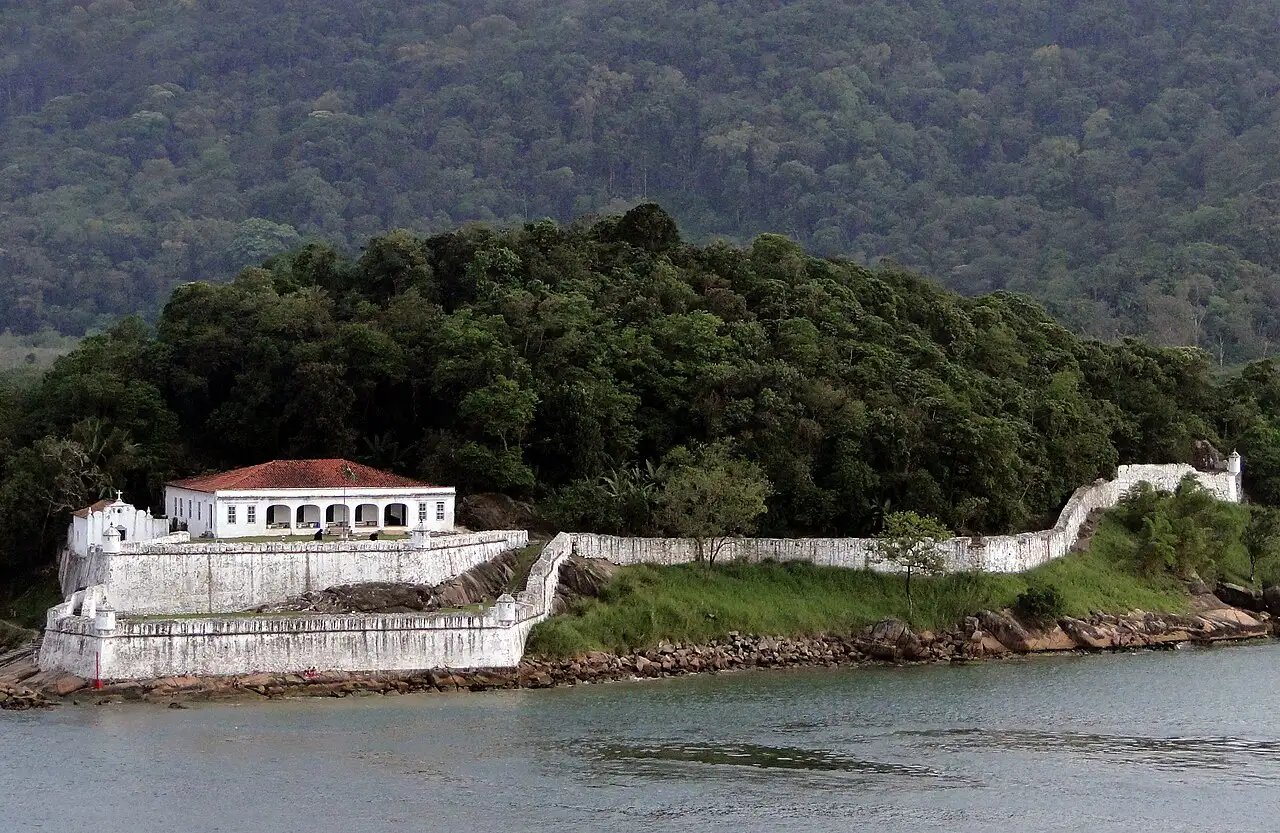
At the mouth of the estuary, between the Góes and Santa Cruz dos Navegantes beaches in Guarujá, stands the Fortaleza de Santo Amaro da Barra Grande. Built in 1584 to protect the town of Santos from pirate attacks, it served as a political prison in the 17th century, underwent a first restoration in 1885 and was listed as a heritage site by IPHAN in 1964. Today it operates as a museum with free admission, and it is the best place to understand why the harbor entrance was fought over for centuries.
More than three centuries later, during the Second World War, the Army built the Forte dos Andradas, opened in 1942 between Tombo and Guaiúba, with tunnels carved into the rock to conceal cannons. The area is military and houses the 1st Anti-Aircraft Artillery Brigade; visits are free and require advance booking.
The seaside resort town and the "Pearl of the Atlantic"
Guarujá as a beach destination was a private venture. In 1892, the Companhia Prado Chaves created a seaside resort town in Pitangueiras, inaugurated on September 2, 1893, around the La Plage hotel. The hotel was rebuilt in 1912 as the Grand Hôtel de la Plage and became the center of the island's social life. The nickname "Pearl of the Atlantic", which has stayed with the city to this day, dates from this period. The seaside resort district was created in 1934, and the municipality gained full autonomy in 1947.
It was at the Grand Hôtel de la Plage that Alberto Santos-Dumont died in 1932, an episode that links the hotel's history to that of Brazilian aviation.
The tracks of the Maria Fumaça
Before the highways, the link between the resort town and the crossing to Santos was made by train. The locomotive on display at the Pavilhão da Maria Fumaça, on Avenida Leomil, in downtown Guarujá, was built in 1891 in the United States and ran this route until it was decommissioned in 1956. Admission is free, Tuesday through Sunday.
Names that tell the geography
The names of Guarujá's beaches describe the places themselves. Tombo owes its name to the steep drop of the seabed, which forms the waves that attract surfers. Perequê, from the Tupi language, is associated with "entrance of fish" or "river of fish", after the river that flows into the sea there, where the city's largest fishing community is located.
The Mar Casado (Married Sea) is the high-tide phenomenon that covers the sandbar between the beach and the neighboring island, "marrying" the waters on either side. Praia Preta (Black Beach) takes its name from the dark rocks that contrast with the light sand of neighboring Praia Branca (White Beach).
Santos, the town of Brás Cubas
Across the channel, Santos was founded by Brás Cubas in 1546. Before that, in 1543, he had already established the Santa Casa de Misericórdia de Todos os Santos, considered the oldest hospital institution still operating in Brazil. At the top of Monte Serrat, 147 meters high, the chapel of Nossa Senhora do Monte Serrat, the city's patron saint, dates from 1603 and is reached by a funicular from downtown.
Coffee, the port and the streetcar
The organized port was inaugurated in 1892, now has about 13 km of quays and handles more than a quarter of Brazil's foreign trade cargo. At the height of the coffee era, the city gained the Bolsa Oficial do Café (Official Coffee Exchange), inaugurated in 1922, with Carrara marble and crystal chandeliers, which now houses the Museu do Café.
Santos was the second Brazilian city to have streetcars, after Rio de Janeiro: the first line began operating in 1871, was electrified in 1909, and regular service ended in 1971. In the early 2000s, the streetcar returned as a tourist ride through the Historic Center, on a route of about 5 km.
The seafront of canals and gardens
The Santos seafront landscape is a feat of engineering. The drainage canals designed by Saturnino de Brito in the early 20th century drained the floodplains and organized the beach neighborhoods, numbered 1 to 6. The same engineer proposed, in a 1914 study, the gardens facing the sea, built from 1936 onward. They stretch 5,335 meters between José Menino and Ponta da Praia, 45 to 50 meters wide, with more than 900 flower beds and 38 monuments, and have been recognized by Guinness since 2002 as the world's largest beachfront garden.
Leaning buildings and other singularities
Santos is known for the leaning buildings along its seafront, built on a layer of clay that settled unevenly over the decades. About 90 buildings have a visible tilt; the most frequently cited case, the Edifício Núncio Malzoni, in Boqueirão, reached a deviation of more than two meters before being straightened. The city also has the Aquário Municipal, from 1945, the oldest in the country, and, according to the 2022 Census, the highest proportion of women among Brazilian municipalities: 54.7% of the population.
Knowing these stories also helps when evaluating properties: the age of the buildings, the seafront soil and the proximity of the port and the forts are part of what we at Grando Soluções Imobiliárias analyze with our partners on every visit.
More in Essential Information
Sources consulted (8)
- QuintoAndar Guides — What to do in Guarujá: forts, Maria Fumaça, Acqua Mundo and restaurants (quintoandar.com.br)
- Wikipedia — Guarujá (population from the 2022 Census, area, official beaches, history) (pt.wikipedia.org)
- Viagens e Caminhos — What to do in Guarujá: beaches, fortress and gastronomy (updated 20/03/2026) (viagensecaminhos.com)
- Melhores Destinos — Beaches of Guarujá (updated 03/07/2026) (guia.melhoresdestinos.com.br)
- Wikipedia — Santos (Census 2022, HDI, founding, port, streetcars, Coffee Exchange) (pt.wikipedia.org)
- Viagens e Caminhos — Santos: attractions, museums, bars and restaurants (updated 14/10/2025) (viagensecaminhos.com)
- Estado de Minas — Santos: Guinness-listed waterfront gardens, HDI, port and leaning buildings (10/03/2026) (em.com.br)
- Poder360 — Santos has 418.608 residents and the highest proportion of women in the country (Census 2022) (poder360.com.br)
Information verified on 01/11/2026. Found something outdated? Let our team know.