
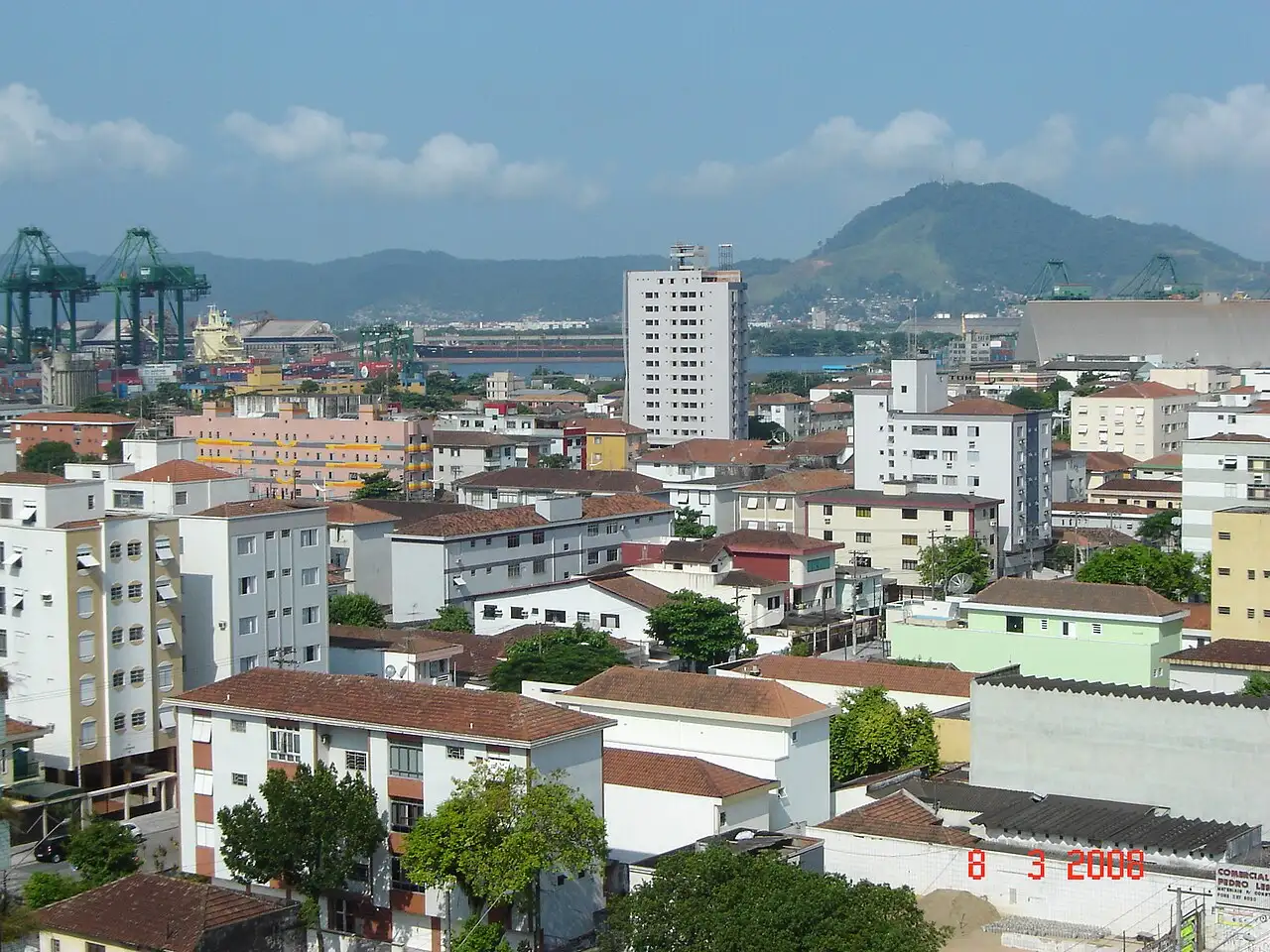

For decades, a fixed link between Santos and Guarujá has appeared in campaign promises. In 2026, it gained a contract, a concessionaire and a timeline. The Santos–Guarujá immersed tunnel is the most significant infrastructure project in the Baixada Santista this decade, and it changes the way the real estate map of the two cities is read. Here we gather what is confirmed, what still depends on further stages and how we assess the effect on property.
What it is and who is building it
The project is a public-private partnership of the State of São Paulo, with participation by the federal government. The auction was held on B3 on September 5, 2025 and won by the Portuguese group Mota-Engil, with a 30-year concession to build, operate and maintain the link. The company created for the project, TSG Concessionária, signed the contract in January 2026 and, in July, formally took over the areas and activities required for the works through the Initial Transfer Agreement (Termo de Transferência Inicial).
The estimated investment is R$ 6.8 billion, of which about R$ 5.1 billion comes from public funds, split equally between the State and the federal government. In April 2026, the State formalized a R$ 2.57 billion credit operation with Banco do Brasil to cover part of its share.
The route
The link will be about 1.5 km long, of which approximately 870 meters will be submerged beneath the navigation channel of the Port of Santos, with the base of the tunnel at a depth of about 21 meters. The connection points are Ponta da Praia, in Santos, and Jardim Santo Antônio, in Vicente de Carvalho, Guarujá. On the Guarujá side, a new access road of about 2 km will connect the tunnel to the Rodovia Cônego Domênico Rangoni.
There will be three lanes in each direction, one of them prepared to accommodate the VLT light rail in the future, as well as walkways for pedestrians and cyclists and a utility gallery for service networks. The construction method is that of an immersed tunnel: large concrete modules are fabricated in a dry dock, floated to the site and sunk into a trench dredged in the channel bed, with no direct underwater excavation.
Year-by-year timeline
| Year | Planned stage |
|---|---|
| 2026 | Functional and detailed designs, complementary studies, expropriations and environmental licensing |
| 2027 | Construction sites, dry dock and preliminary dredging: start of civil works |
| 2028 | Fabrication of the precast modules |
| 2029 | Immersion and assembly of the modules |
| 2030 | Finishing, operating systems and testing |
| 2031 | Planned start of operations |
Crossing time should drop to about five minutes, compared with waits of up to an hour for the ferry at peak times. Timelines for works of this scale are often adjusted; we will follow each stage and update this page.
Toll
The model provides for free flow tolling, with no physical toll plaza: an automatic system identifies the vehicle and charges the amount. On the bid's base date, in February 2025, the reference rates were R$ 6.15 for cars, R$ 3.07 for motorcycles and R$ 18.35 for two- and three-axle trucks and buses. These amounts will be adjusted until operations begin. The ferry will continue to exist, under a new operator, but will no longer be the only direct link.
The effect on real estate
The tunnel does not create value on its own; it reduces the time cost of living on one side and using the other. Our reading, based on what has been contracted, is as follows:
- Ponta da Praia (Santos): this is the most directly affected neighborhood. It will face years of construction and altered traffic until 2031 and, afterward, a link of just minutes to Guarujá. New developments in the neighborhood already cite the tunnel as a selling point; it is worth separating contracted infrastructure from sales promises. See the Ponta da Praia page.
- Vicente de Carvalho and the access via the Cônego Domênico Rangoni: the Guarujá side gains a new gateway. Areas near the tunnel portal and the new access road are likely to draw attention from investors and commercial uses.
- Guarujá's beaches: for those who work or study in Santos, Enseada, Pitangueiras and Astúrias become year-round housing options with a predictable commute.
- Gated communities in the Serra and Pernambuco: the day-to-day effect is smaller, but access to hospitals, schools and the airport via Santos improves.
As a market benchmark, the FipeZAP Index recorded in September 2026 an average price per square meter of R$ 7,024 in Guarujá, up 10.32% over 12 months, and R$ 8,606 in Santos, up 9.22%. These variations cannot be attributed to the tunnel; they reflect the market as a whole.
What to consider before buying
- Check the property's distance from the construction site and the works' access roads: noise and traffic between 2027 and 2031 are part of the package.
- Be wary of premiums charged solely on the promise of the tunnel; compare with equivalent properties in neighborhoods without the works.
- Consider your time horizon: someone buying to live there from 2031 onward evaluates the property differently from someone who needs the link right away.
- Read the guide to buying property in Guarujá for the precautions regarding navy land (terreno de marinha) and laudêmio, common along the waterfront and the banks of the estuary.
Grando Soluções Imobiliárias follows the works and both sides of the channel with local partners and helps buyers measure what the tunnel changes, and what it does not, at each address.
More in Essential Information
Sources consulted (8)
- Correio da Manhã — Santos–Guarujá Tunnel Enters New Phase After Transfer to Concessionaire (13/07/2026) (correiodamanha.com.br)
- CBN Santos — Santos–Guarujá tunnel moves forward and São Paulo State Government confirms construction start for 2027 (11/07/2026) (cbnsantos.com.br)
- Jornal de Brasília — Where the Santos–Guarujá submerged tunnel project stands (13/04/2026) (jornaldebrasilia.com.br)
- Diário do Transporte — Mota-Engil to sign contract for the Santos–Guarujá tunnel (08/11/2025) (diariodotransporte.com.br)
- Diário do Transporte — Mota-Engil will build and operate the immersed tunnel (05/09/2025) (diariodotransporte.com.br)
- IstoÉ Dinheiro — Toll for the Santos–Guarujá tunnel: reference amounts (27/02/2025) (istoedinheiro.com.br)
- Vrum — Brazil's first immersed tunnel will link Santos and Guarujá in 5 minutes (01/10/2026) (vrum.com.br)
- MySide — Price per m² in Guarujá by the FipeZAP Index (September 2026 reference) (myside.com.br)
Information verified on 01/11/2026. Found something outdated? Let our team know.