
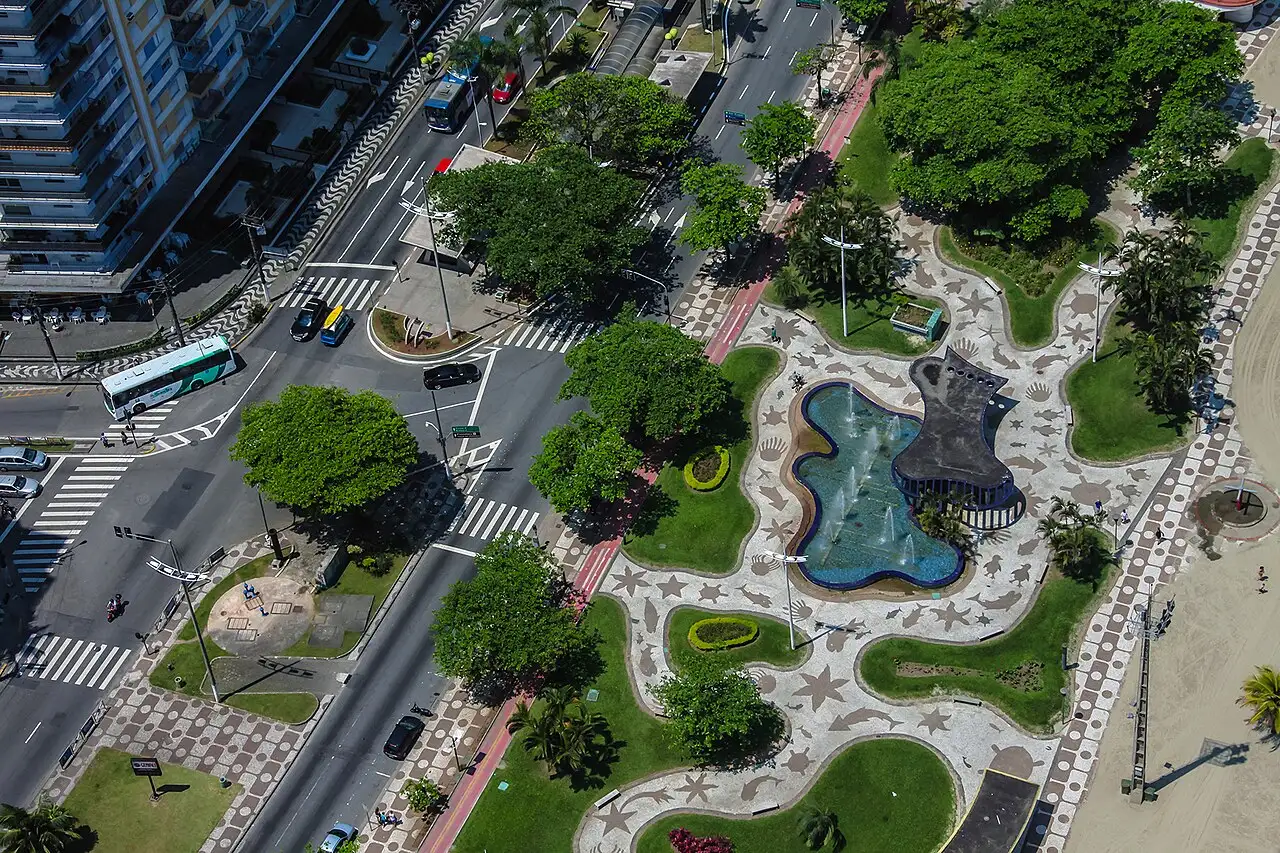

Santos is the city where the coast works like a neighborhood of a major capital. It has a port, universities, leading hospitals and a seafront where people walk, cycle and work all year round. For those coming from São Paulo, the city offers a complete urban routine about 70 km from the capital; for those with a house in Guarujá, it is the services address on the other side of the channel. Here we show what it is like to live in Santos and what to weigh before choosing a neighborhood.
Why Santos
Santos has 418,608 residents according to the 2022 Census and an HDI of 0.840, the sixth best among Brazilian municipalities in the latest measurement. The city also ranks among the top in the country for aging with quality of life and placed eighth in the Instituto Trata Brasil 2024 sanitation ranking. It is a mature city, with the highest proportion of women in the country, 54.7% of the population, abundant health services and neighborhood shops all along the seafront.
The economy revolves around the port, inaugurated in 1892, with about 13 km of quays and more than a quarter of Brazil's foreign trade cargo.
The seafront and the canals
The landscape that defines Santos is its seafront. There are seven beaches between José Menino and Ponta da Praia, separated by drainage canals designed by Saturnino de Brito and numbered 1 to 6, which also serve as address references. The oceanfront gardens stretch for 5,335 meters, 45 to 50 meters wide with more than 900 flower beds, and have been recognized by Guinness since 2002 as the world's largest beachfront garden. The promenade has a bike path, sports courts and exercise equipment, and it is the most used public space in the city.
The beach, however, is more a place for sports and socializing than for swimming: water quality along the Santos seafront is a frequent point of concern in Cetesb's bulletins. Those looking for sea to swim in usually cross over to Guarujá or head on to Bertioga.
The beach neighborhoods
- Gonzaga: the commercial and hotel center of the seafront, between canals 2 and 3, with shopping malls, a movie theater and Rua Gastronômica. Intense urban life and good rental liquidity.
- Boqueirão: between canals 3 and 4, home to traditional schools and high-end new developments on the seafront.
- Embaré and Aparecida: residential, with the Embaré Basilica and Praiamar Shopping, and the most sensibly priced inventory for those who want the seafront.
- Ponta da Praia: the end of the seafront, with rowing clubs, the Aquarium, the ferry to Guarujá and the future immersed tunnel.
- José Menino and Pompeia: at the western end, José Menino has Parque Roberto Mário Santini, a meeting point for surfers and skateboarders; Pompeia offers tree-lined streets and the Municipal Orchid Garden.
Services, schools and health care
The leading private schools are a few blocks from the beach, especially in Boqueirão, Embaré, Aparecida and Ponta da Praia; Unifesp has operated its Baixada Santista campus since 2005. The hospital network includes the Santa Casa, founded in 1543, Beneficência Portuguesa, Hospital Ana Costa, São Lucas, Frei Galvão and Casa de Saúde. The Parque Balneário, Pátio Iporanga and Miramar malls are in Gonzaga; Praiamar is in Aparecida. We cover schools and hospitals in detail in Schools and health care.
Culture and leisure
The Historic Center brings together the Coffee Museum, in the former 1922 Coffee Exchange, the tourist streetcar, the Monte Serrat funicular and the Pelé Museum, opened in 2014. On the seafront, the Pinacoteca Benedicto Calixto occupies a mansion in Boqueirão, and the Municipal Aquarium, from 1945, is the oldest in the country. The rowing clubs of Ponta da Praia, founded in 1895 and 1898, keep the nautical tradition alive, and the Tênis Clube de Santos, from 1923, is one of the city's historic social clubs.
Points to watch
- Leaning buildings: about 90 seafront buildings have a visible tilt, an effect of the clay soil. Request engineering reports and learn about the building's history.
- Parking: part of the older inventory has no parking space or only one.
- Building age: facades, elevators and building systems call for careful inspection.
- Tunnel construction: Ponta da Praia will have construction sites and altered traffic between 2027 and 2031.
- Federal coastal land (terreno de marinha): properties near the sea and the estuary may be subject to SPU charges; see the guide to buying property.
The market
According to the FipeZAP Index, the average residential asking price in Santos was R$ 8,606 per square meter in September 2026, up 9.22% over 12 months, above the Guarujá average. Oceanfront apartments and new developments are well above this average; the older inventory on the inner streets is close to it or below. High-end new developments in Santos are concentrated in Boqueirão, Embaré and Ponta da Praia.
Grando Soluções Imobiliárias serves Santos with local partners and helps buyers compare neighborhoods, older buildings and new towers based on the lifestyle they want.
More in Living in the Baixada
Sources consulted (8)
- Poder360 — Santos has 418.608 residents and the highest proportion of women in the country (Census 2022) (poder360.com.br)
- Estado de Minas — Santos: Guinness-listed waterfront gardens, HDI, port and leaning buildings (10/03/2026) (em.com.br)
- MySide — Price per m² in Santos by the FipeZAP Index (reference September 2026) (myside.com.br)
- Viagens e Caminhos — Santos: attractions, museums, bars and restaurants (updated 14/10/2025) (viagensecaminhos.com)
- Quero Viajar Mais — Neighborhoods and hotels of Santos (updated 16/06/2026) (queroviajarmais.com)
- QuintoAndar Guides — Shopping Malls in Santos, with addresses (quintoandar.com.br)
- QuintoAndar Guides — Traditional Clubs in Santos (quintoandar.com.br)
- Wikipedia — Santos (Census 2022, HDI, founding, port, streetcars, Coffee Exchange) (pt.wikipedia.org)
Information verified on 01/11/2026. Found something outdated? Let our team know.