
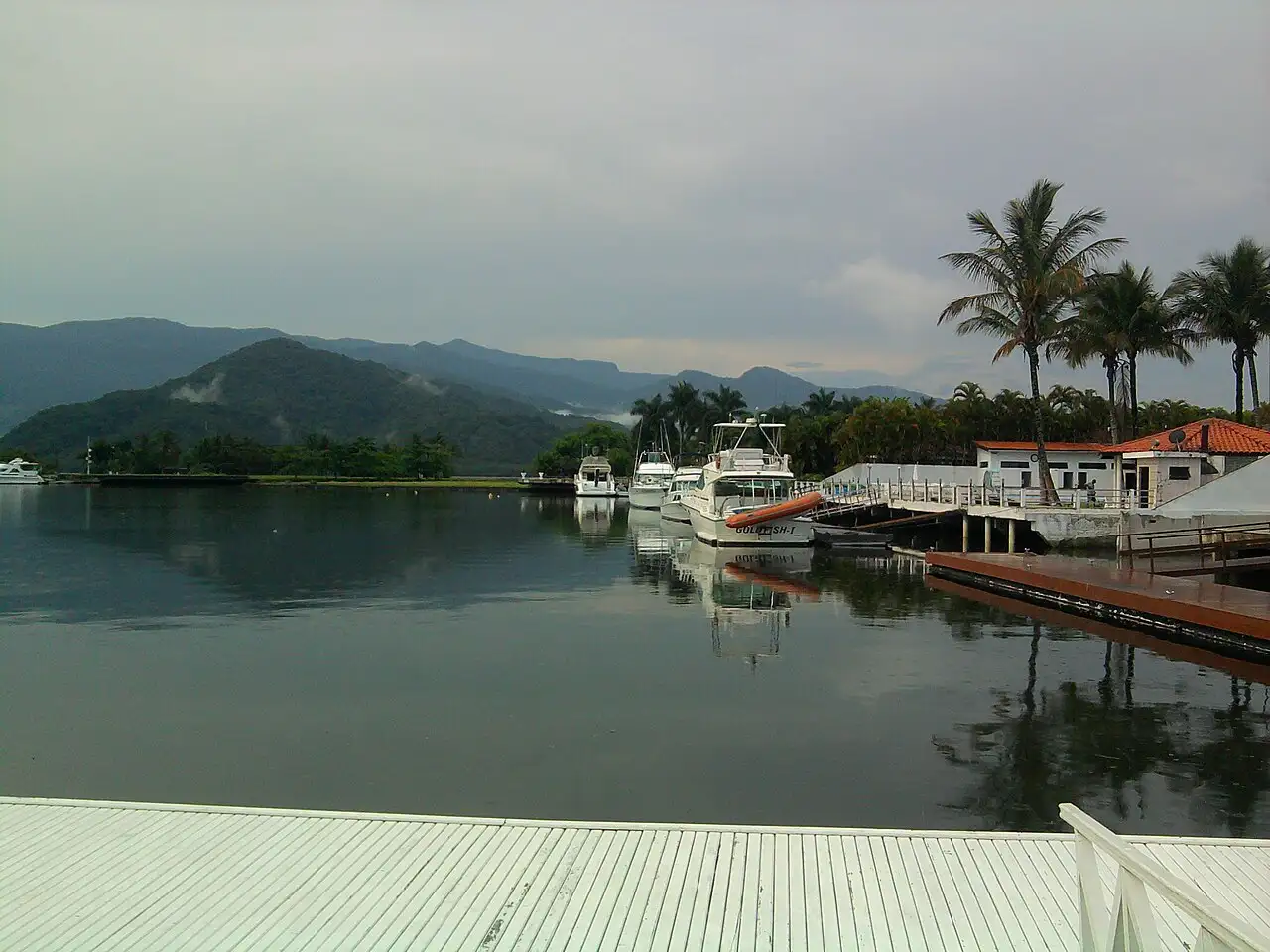

Guarujá is an island, and that defines its nautical life. Ilha de Santo Amaro connects to the mainland by bridge and by ferries and has, on one side, the estuary and the channel of the Port of Santos; on the other, the Bertioga Channel; and, in front, the open sea.
For boat owners, this means choosing between very different navigation environments just a few kilometers apart. In this article we gather the verifiable nautical addresses on the island and around it, from Santos's century-old clubs to homes with private docks on the Bertioga Channel, and what to consider before deciding where to live and where to keep your vessel.
Three waters, three kinds of navigation
- The Santos estuary. It is the entrance to the port channel, described by the Santos City Government as the largest and most important in Latin America. There, recreational boating coexists with ships, tugboats and the ferries that cross between Santos and Guarujá 24 hours a day, in a crossing of about seven minutes.
- The Bertioga Channel. Sheltered waters between the north of the island and the mainland, with the Serra do Guararu on one side. This is where the homes with private docks are located, and it is the route to Bertioga and the Litoral Norte (North Coast).
- The open sea. From the beaches on the south and east of the island, boaters reach the coastal islands and dive sites.
The traditional clubs, in Ponta da Praia
The region's nautical culture was born on the other side of the estuary, on Avenida Almirante Saldanha da Gama, in Ponta da Praia, Santos. There stand the Clube de Regatas Saldanha da Gama, founded in 1895, the Clube Internacional de Regatas, from 1898, and the Clube de Regatas Vasco da Gama, from 1923. The Internacional is the one that keeps a foothold in Guarujá: its nautical facility is on the island, a few kilometers from its social headquarters, and the club lists rowing, sailing, water polo and swimming among its sports. Vasco da Gama offers canoeing.
For Guarujá residents, the ferry puts these clubs within reach of a short crossing. On the Guarujá side, boarding is at Avenida Ademar de Barros, 3300; on the Santos side, at Praça Gago Coutinho, 525, at the end of Avenida Rei Pelé, near the Edgard Perdigão Bridge, where the sightseeing schooners depart.
In the Santos–Guarujá direction the crossing is free; the fare is charged in the opposite direction, and a paid reservation is available to avoid the line. At the harbor mouth, the Fortaleza de Santo Amaro da Barra Grande, built in 1584 to defend the port, is the historic landmark at the entrance to the estuary.
A marina at home: Marinas Guarujá
For those who want their boat at the doorstep, Marinas Guarujá is the best-known address on the island. The gated community is at km 10.5 of the Estrada Guarujá–Bertioga, on the banks of the Bertioga Channel, in an area of about 814,000 m², with water access through three secondary channels deep enough for sizable vessels.
Every residence has a private dock, and there is an area reserved for a future nautical center. An agreement with neighboring gated communities in the Serra do Guararu, such as Iporanga, Sítio São Pedro, Tijucopava and Taguaíba, guarantees use of their beaches, combining a waterfront home and an open-sea beach in the same routine. To learn about the beaches in the hills, see Iporanga and São Pedro.
From the island to Riviera de São Lourenço
Via the Bertioga Channel, boaters reach Bertioga and, from there, along the coast, Riviera de São Lourenço, the main destination of the Grando network. The Riviera is planning its own marina, which is part of the neighborhood's original master plan. Presented in October 2026 with 400 slips, dry and wet, for vessels up to 60 feet, it is planned next to Modules 1 and 9, the last oceanfront modules; the idea is that residents drive from São Paulo, leave the car at home and continue by boat.
A court settlement with the Federal Public Prosecutor's Office also provides for a naval support point in the future facilities. Sobloco, the Riviera's developer, stated that there is no timeline for the start of construction, which depends on new designs and coordination with public agencies. Those buying today with the marina in mind should treat it as a possibility, not a date. More about the Riviera at grandoriviera.com.br.
The tunnel and navigation in the estuary
The Santos–Guarujá immersed tunnel will be about 1.5 km long, of which about 870 meters run under the port's navigation channel, with an estimated investment of R$ 6.8 billion. Construction begins in 2027, with work sites, a dry dock and preliminary dredging in the channel; fabrication of the modules is scheduled for 2028, immersion for 2029 and delivery for 2031, with a crossing time of about five minutes.
For those who navigate the estuary, the coming years will bring work zones to respect and notices from the maritime authority to follow; for Guarujá residents, the fixed link should bring the nautical clubs and services on both sides closer together.
How to choose where to keep your boat
- Dry or wet slip. A dry slip protects the hull and reduces maintenance; a wet slip makes it quicker to head out. The choice depends on the size and use of the boat.
- Draft and tide. Channels and estuaries have shallow stretches. Confirm the depth at the dock at low tide, not at high tide.
- Usual destination. Those heading to the Litoral Norte save time leaving via the Bertioga Channel; those sailing to the southern islands are better off leaving from the estuary side.
- Community or club rules. Maximum boat size, hours, visitor mooring, fueling and cleaning.
- Documentation. Operator's license and vessel registration with the Capitania dos Portos (Harbor Master's Office), plus insurance. For a home with a dock, confirm the legal status of the structure on the shoreline, which is federal property.
We at Grando Soluções Imobiliárias serve buyers of waterfront homes in Guarujá with local partners and with our experience in the Riviera de São Lourenço nautical market.
More on Boating
Sources consulted (8)
- Cássio Imóveis — profile of Condomínio Marina Guarujá (area, channels, pier and beach agreement) (cassioimoveis.com)
- QuintoAndar Guides — Traditional Clubs of Santos (updated December 2024) (quintoandar.com.br)
- Melhores Destinos — Guarujá Guide: Island, Ferries and Fortaleza da Barra Grande (July 2026) (guia.melhoresdestinos.com.br)
- Melhores Destinos — Santos–Guarujá Ferry: Schedules, Boarding and Fares (July 2026) (guia.melhoresdestinos.com.br)
- CBN Santos — Santos–Guarujá Tunnel Moves Forward, Works Begin in 2027 (11/07/2026) (cbnsantos.com.br)
- Grando Riviera — Riviera Enters a New Phase: Marina, Resort and Signature Architecture (31/10/2026, from Valor Econômico) (grandoriviera.com.br)
- Grando Riviera — Module 1 and the Future Marina: Sobloco Statement and Agreement with the MPF (grandoriviera.com.br)
- Turismo Santos (City Hall) — Edgard Perdigão Bridge and Schooner Tours (turismosantos.com.br)
Information verified on 01/11/2026. Found something outdated? Let our team know.