
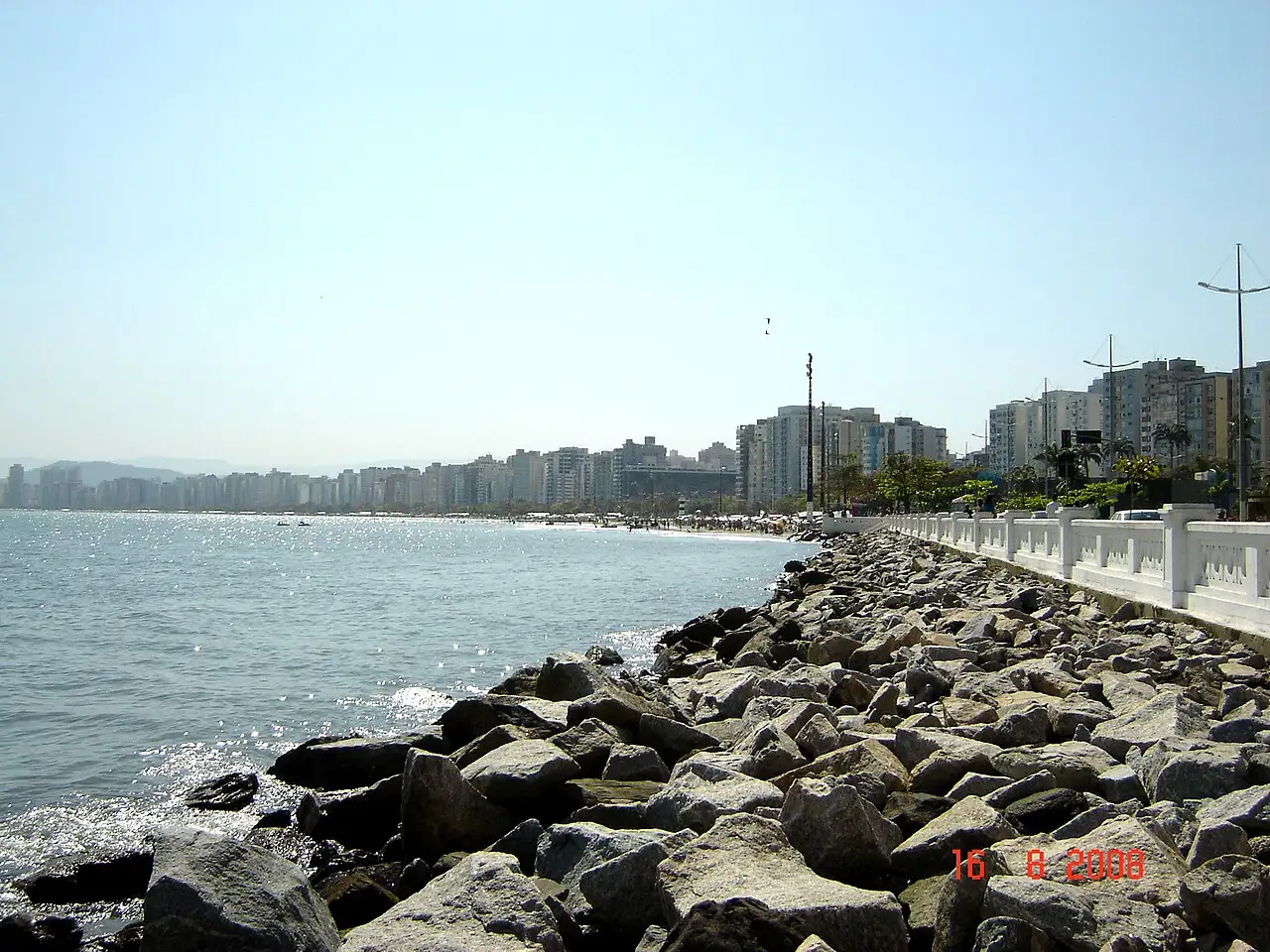

Ponta da Praia is where the Santos waterfront ends and the estuary begins. It is the most residential and tranquil neighborhood along the beach, with tree-lined streets, long-established families and a direct relationship with the sea: from here depart the ferries to Guarujá, the boats of the rowing clubs and, from 2031, the traffic of Brazil's first immersed tunnel. We recommend it to families who want peace and quiet and schools within walking distance, to boating enthusiasts and to investors attentive to what the Santos–Guarujá tunnel will change in the region.
History and profile
Ponta da Praia is the last of Santos' seven beaches from west to east, at the end of the 5,335 meters of beachfront gardens that line the waterfront from José Menino and have been recognized by Guinness since 2002. The neighborhood grew around the nautical clubs and the port: Clube de Regatas Saldanha da Gama, founded in 1895, and Clube Internacional de Regatas, from 1898, are on Avenida Almirante Saldanha da Gama, alongside Clube de Regatas Vasco da Gama, from 1923. It is the city's oldest rowing and sailing tradition.
The Aquário Municipal de Santos, on Avenida Bartolomeu de Gusmão, opened in 1945 and is the oldest in Brazil; renovated in 2004 and reopened in 2006, it covers 3,000 square meters and welcomes nearly half a million visitors a year. Next door, the Museu de Pesca and the Mercado de Peixes complete the neighborhood's maritime character, and the Deck do Pescador is the lookout from which to watch ships entering and leaving the estuary.
Streets, greenery and services
The inner streets are wider and more tree-lined than in Gonzaga and Boqueirão, with remaining houses among the buildings. Retail has a neighborhood character, with bakeries, markets and local restaurants; the shopping malls are in Aparecida and Gonzaga. The 400-meter Emissário Submarino landfill has become a leisure area with a promenade, the Museu do Surf, a skate park, Praça das Gerações, sports courts and the Monument to the 100 Years of Japanese Immigration.
The crossing and the Santos–Guarujá tunnel
The ferry to Guarujá departs from Praça Gago Coutinho, 525, in Ponta da Praia, and for decades it has been the lifeline between the two cities. It is about to be replaced: the Santos–Guarujá immersed tunnel, a R$ 6.8 billion public-private partnership awarded to the Mota-Engil group in September 2025, under a 30-year concession. TSG Concessionária signed the contract in January 2026 and took possession of the sites in July.
The tunnel will be approximately 1.5 kilometers long, 870 meters of which will be immersed beneath the port channel, with six traffic lanes, one of them adaptable to a future light rail line, plus walkways for pedestrians and cyclists. The schedule calls for design and permitting in 2026, site preparation and dredging in 2027, fabrication of the modules in 2028, immersion in 2029, finishing work in 2030 and operation in 2031. For Ponta da Praia, this means several years of construction and, afterwards, a connection of just minutes to Vicente de Carvalho and the Rodovia Cônego Domênico Rangoni.
Schools, health and well-being
Two traditional schools are located in the neighborhood: Colégio Universitas, at Rua Vereador Henrique Soler, 229, and Colégio do Carmo, at Rua Dr. Egydio Martins, 181. For healthcare, the nearest private hospitals are in Boqueirão: Hospital Frei Galvão and Casa de Saúde de Santos. The rowing clubs offer rowing, sailing, swimming and an active social life.
Entertainment and dining
Ponta da Praia is understated at night. Dining revolves around fresh fish from the Mercado de Peixes and neighborhood restaurants; for hotels, the Sheraton Santos Hotel is the high-end benchmark, alongside smaller properties. For bars, cinemas and shopping malls, Gonzaga is a few minutes away along the waterfront.
New developments and the real estate market
The neighborhood has been attracting high-end new developments on lots previously occupied by houses. In November 2026, new-construction platforms listed four projects under way in Ponta da Praia, with floor plans from 55 to 214 square meters; the largest offers apartments from 113 to 214 square meters with resort-style amenities, and another has 148-square-meter floor plans.
Prices were available upon request. For Santos as a whole, the FipeZap index recorded, in September 2026, an average sale price of R$ 8,606 per square meter, up 9.22% over 12 months; in Ponta da Praia, apartments overlooking the harbor entrance and new developments are priced above the average, while the older stock on the inner streets sits below it.
What to look for: the view of the estuary, which changes with port activity; parking spaces in older buildings; the impact of the tunnel construction on traffic until 2031; and the condominium bylaws in buildings with few units.
At Grando Soluções Imobiliárias, we follow Ponta da Praia alongside local partners and with an understanding of what the Santos–Guarujá tunnel means for those buying now.
More in Neighborhoods
Sources consulted (8)
- Correio da Manhã — Santos–Guarujá tunnel enters a new phase (July 2026) (correiodamanha.com.br)
- Vrum — Brazil's first submerged tunnel will link Santos and Guarujá (October 2026) (vrum.com.br)
- Buser — Santos Municipal Aquarium (address and hours) (buser.com.br)
- QuintoAndar Guias — traditional clubs in Santos (quintoandar.com.br)
- Viagens e Caminhos — Santos: Aquarium, Emissário and waterfront (viagensecaminhos.com)
- Quero Viajar Mais — Santos neighborhoods and hotels (updated June 2026) (queroviajarmais.com)
- Comércio São Paulo — private schools in Santos (comerciosaopaulo.com.br)
- Apto — new developments in Ponta da Praia (November 2026) (apto.vc)
Information verified on 01/11/2026. Found something outdated? Let our team know.