
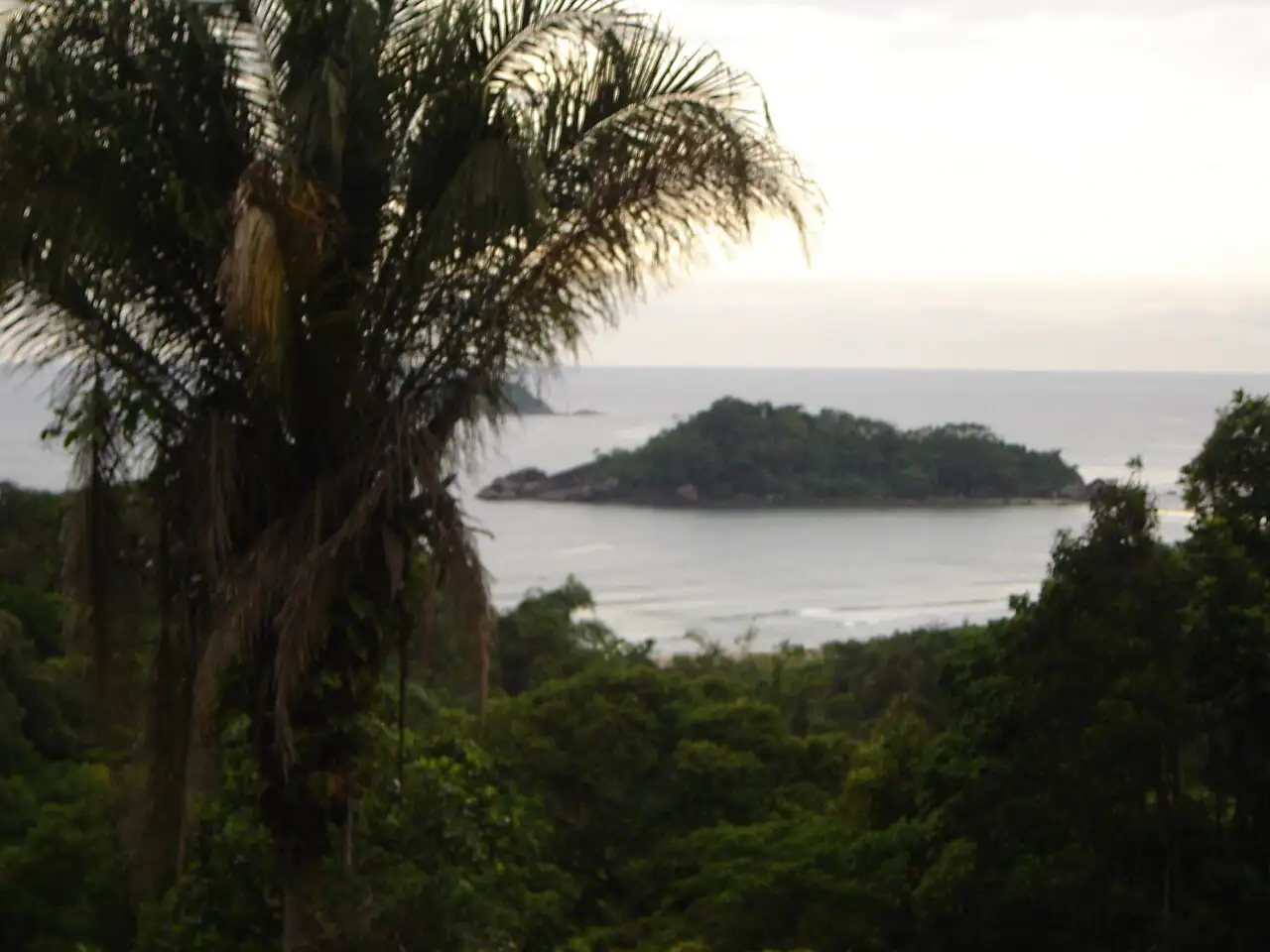

Praia Branca, which locals call Prainha Branca, is the last of Guarujá's 27 beaches, at the northern tip of Ilha de Santo Amaro, on the shore of the Bertioga Channel. It cannot be reached by car: the way in is a paved trail through the Atlantic Forest, which begins next to the ferry to Bertioga, or by boat.
On the other side lies a caiçara village with sandy lanes, simple campsites and guesthouses, in a protected area of the Serra do Guararu. It is a destination for a day at the beach, for surfers and for those who want to get to know a traditional community; it is not, as we will see, a place to buy a vacation home.
The beach and the sea
The cove has just over 1 km of white sand, which gives the place its name; an academic study of the community refers to more than 1.35 km of shoreline. The sea changes from one end to the other. On the left side, the waves are strong and make the beach one of the favorite surf spots in Guarujá, with the best conditions on south swells; on the right side, the water is calmer and suitable for swimming. The beach sits between forested hills, and the area ends in mangroves, the habitat of the guaiamum, an endangered land crab.
A caiçara village in a protected area
Settlement began around 1840, with families from Ilha Montão de Trigo, in São Sebastião. Today the village has about 400 residents in 108 families, according to the local association and, according to an anthropological report cited in an academic study, more than 84% of the dwellings belong to traditional families. The Sociedade Amigos da Prainha Branca, founded in 1972, handles garbage collection, carried out by boat, as well as safety, education and community-based tourism initiatives. Traditional festivities such as the Reizado remain on the calendar.
Prainha Branca and the Serra do Guararu have been listed as heritage by Condephaat since 1992 for their natural and cultural attributes, and the beach lies within two environmental protection areas: the APA Serra do Guararu, created by the municipality in 2012 and covering about 25.6 km², and the APA Marinha do Litoral Centro.
The area is known as the "Dragon's Tail" ("Rabo do Dragão") because of its shape on the map. In 2023, the city government began counting visitors with a turnstile on the trail, to study how many people the beach can accommodate without harming residents and the preservation area; an environmental fee was considered, but no admission is charged.
Dining and social life
The facilities are rustic and sufficient. There are restaurants and snack bars on the sand and small businesses within the village; Recanto da Ilha Bar, with tables under the trees, a swing facing the sea and tables almost in the water, is the best known.
In 2012, the community had 11 guesthouses, 25 camping areas and 16 shops; a 2023 news report counted about 30 campsites, with capacity for more than a thousand tents. There are no hotels. In summer and on holidays, the village receives up to 4,000 people, according to a survey by the community itself, and tents are not permitted on the sand.
Access and distances
The beach is almost 30 km from Guarujá's town center, at the end of the Estrada Guarujá–Bertioga (SP-061). Cars are left in the paid parking lots next to the ferry; in April 2025, the daily rate was R$ 35, with higher prices on weekends and in high season.
From there, the paved trail is about 800 meters long, with ups and downs, much of it under the trees, and takes 20 to 30 minutes; it is advisable not to walk it alone. Small boats also go to the beach, and the schooner tour departing from downtown Bertioga passes by it on its route along the channel. From Praia Branca, a trail of about two hours, of high difficulty, continues to Praia Preta and Camburi.
The property profile
Praia Branca does not have a second-home market like that of the neighboring beaches. The village lies in a listed heritage area and within an APA, the dwellings belong mostly to traditional families and there is no car access, which makes buying a house or plot, when one appears, a transaction of high legal risk: possession without a registered title, environmental restrictions and community rules weigh more than the view.
For those who love the place, the safe path is to enjoy it as a visitor and look for a home in the Serra do Guararu, in gated communities such as Iporanga and São Pedro, or at Marinas Guarujá, on the shore of the same channel.
At Grando Soluções Imobiliárias, we serve Guarujá and the Serra do Guararu with local partners and guide those who want a home near this landscape with full legal certainty.
More on Beaches
Sources consulted (8)
- Melhores Destinos — Praia Branca, Guarujá (updated July 2026) (guia.melhoresdestinos.com.br)
- Melhores Destinos — Guarujá beaches (distances and characteristics) (guia.melhoresdestinos.com.br)
- CNN Brasil / Estadão Conteúdo — Guarujá wants to control access to Prainha Branca (20/11/2023) (cnnbrasil.com.br)
- Revista Brasileira de Ecoturismo — Proposal for organizing the camping areas of Prainha Branca (2013) (periodicos.unifesp.br)
- ICLEI South America — APA Serra do Guararu (municipal decree of 2012) (americadosul.iclei.org)
- Viagens e Caminhos — Guarujá beaches: Praia Branca, trails and Reizado (viagensecaminhos.com)
- Bertioga City Hall — Schooner tour along the Bertioga Channel (bertioga.sp.gov.br)
- Mondo Surf — Praia Branca: waves and coordinates of the surf spot (mondo.surf)
Information verified on 01/11/2026. Found something outdated? Let our team know.